
Avowed and Kingdom Come: Deliverance 2 Are Two Sides of the Same RPG Coin
Avowed and Kingdom Come: Deliverance 2 offer deep, old-school RPG experiences with distinct fantasy and historical styles.
From the outside, Avowed and Kingdom Come: Deliverance 2 look like wildly different adventures. Obsidian Entertainment sends players into the Living Lands of Eora to investigate a spreading, plague-like corruption. Warhorse Studios, by contrast, returns to early 15th-century Bohemia, where Henry continues a grim story of civil war, revenge, and personal discovery. Yet beneath those surface differences, the two games share a surprisingly old-fashioned heart.
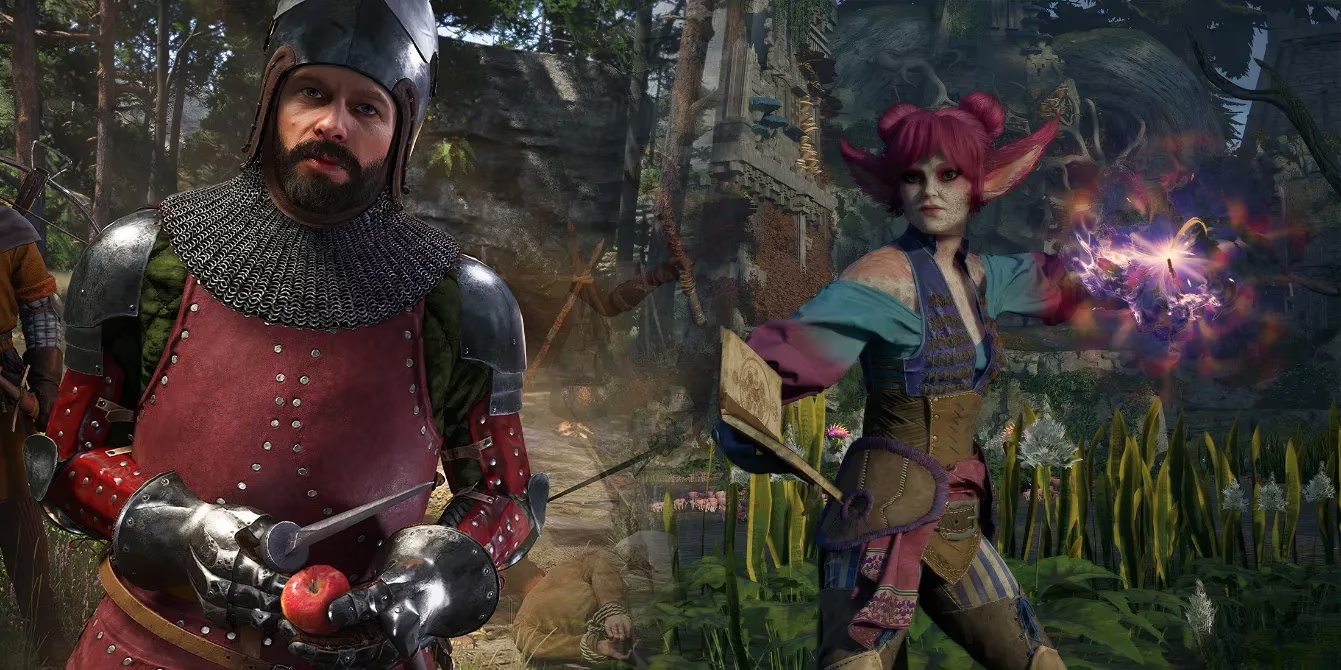
Both titles arrived in February 2025. Avowed launched on February 18, while Kingdom Come: Deliverance 2 arrived on February 4. By 2026, genre veterans have had plenty of time to compare the two, and the conversation keeps circling back to a single idea: they are two sides of the same coin.
At their core, both games lean into traditional RPG depth. Many modern blockbusters have been criticized for sanding down their rough edges. Starfield and Dragon Age: The Veilguard are often mentioned in that discussion. Avowed and Kingdom Come: Deliverance 2 push back. They emphasize rich history, political intrigue, strong storytelling, and fulfilling characterization. Those qualities have always been pillars of old-school role-playing games.
Player agency matters in both experiences. Decisions shape the narrative. Relationships with NPCs can be molded, not merely completed like checkboxes. A player’s choices ripple outward in ways that feel intentional. Exploration, dialogue, and role-playing are just as important as emerging victorious in combat. Worldbuilding and immersion are not afterthoughts; they sit at the foundation of every system.
Still, the presentation could hardly be more different. Avowed embraces high fantasy. Magic, gods, and mystical lore are everywhere. The gameplay reflects that tone, mixing swords and bows with spells and supernatural combat tactics. It is a place of glowing ruins, strange magic, and epic possibility.

Kingdom Come: Deliverance 2 goes in the opposite direction. It grounds itself in realism. History shapes both the story and the mechanics. Henry is not a prophesied hero with a magical gift. He is an ordinary blacksmith’s son caught in extraordinary events. Medieval combat is challenging, grounded, and authentically brutal. The open world feels lived in, from busy streets to quiet forests, and the experience depends on authenticity rather than fantasy.
The contrast becomes clearer in a simple table.
| Element | Avowed | Kingdom Come: Deliverance 2 |
|---|---|---|
| Setting | Living Lands of Eora | 15th-century Bohemia |
| Tone | High fantasy | Historical realism |
| Protagonist | Investigator with magical options | Henry, an ordinary blacksmith |
| Combat | Swords, bows, and spells | Realistic medieval combat |
| Shared core | Old-school depth, player agency, immersion | Same |
That shared core is the reason both games feel like a return to form. They reward careful players. They ask people to read, listen, and choose. They do not simply guide players from one combat arena to the next. Instead, they invite players to inhabit a world and live with the consequences of their decisions.
Of course, some players will prefer one flavor over the other. High-fantasy fans may gravitate toward Avowed for its spectacle and supernatural combat. Historical drama fans may prefer Kingdom Come: Deliverance 2 for its grounded tone and brutal medieval stakes. Both groups, however, are chasing the same thing: a meaningful role-playing experience.
That matters in 2026, when the genre often swings between massive open worlds and heavily streamlined action. Many releases promise choice but deliver only cosmetic differences. Avowed and Kingdom Come: Deliverance 2 stand apart by remembering what made classic RPGs special. They are different in style, but their foundations are remarkably aligned.
Critics noticed the strength of both titles at launch. Avowed earned a solid OpenCritic average around 80, while Kingdom Come: Deliverance 2 climbed closer to 89. Those numbers reflect more than polish. They reflect a sense of substance, a willingness to trust players with complex systems and tough decisions.
That is not always easy. It takes confidence to make a game that does not hold everyone’s hand. Obsidian and Warhorse both made that choice, even though they built different worlds. One side offers magic. The other offers history. The coin, however, remains the same: an old-school RPG with real depth beneath the surface.