
Avowed's Dialogue Camera: A Call for Cinematic Freedom
Avowed dialogue camera and accessibility options redefine RPG immersion, blending cinematic storytelling with player-driven customization.
In the ever-evolving landscape of modern RPGs, where player agency and immersive storytelling are paramount, the technical scaffolding that supports narrative delivery often becomes a silent character in its own right. As of 2026, Obsidian Entertainment's Avowed stands as a testament to robust accessibility, offering players a detailed tapestry of toggles and sliders to tailor combat, HUD elements, and sensory feedback to their precise liking. Yet, within this commendable suite of options, a particular cinematic convention remains stubbornly fixed: the dialogue camera. This persistent close-up on conversing characters, while functional, can feel like a beautifully rendered cage, restricting the player's visual freedom during the game's most pivotal narrative moments. It is a design echo from an older era of RPGs, one that contemporary titles are increasingly challenging.
The Legacy of the Stilled Frame
The tradition of the static, face-to-face dialogue exchange is a deeply ingrained one, particularly within the lineage of Bethesda's RPGs. For decades, from the irradiated wastes of Fallout 3 to the frozen peaks of Skyrim, conversations were largely transactional visual exchanges, amounting to minutes spent studying the often-stoic visage of an NPC. This approach framed dialogue as a menu-driven interface rather than a dynamic, cinematic event. Starfield initially inherited this legacy, its conversations unfolding like a series of meticulously detailed but motionless portraits. This stood in stark contrast to the fluid, multi-perspective dialogue of peers like Baldur's Gate 3, where conversations felt like organic scenes within a living world, or the gritty, reactive exchanges of Kingdom Come: Deliverance 2.
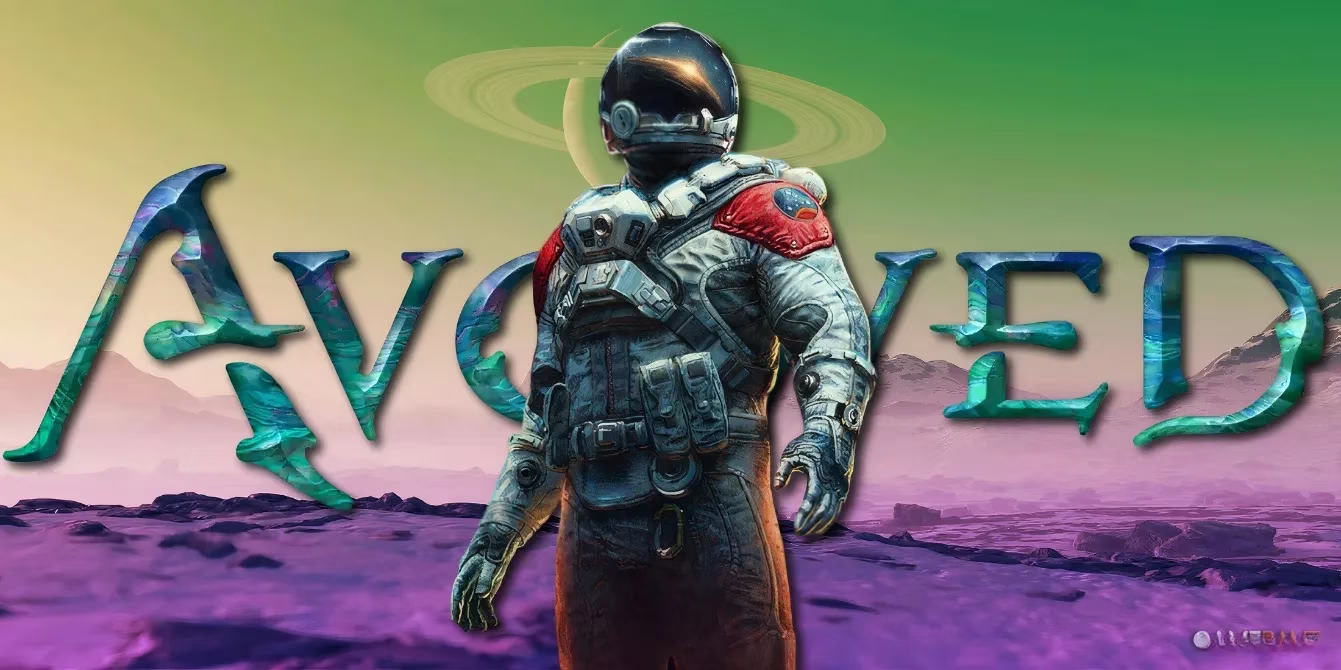
A Blueprint for Change: Starfield's Evolution
A significant shift occurred in mid-2024 when Bethesda, in a post-launch update for Starfield, introduced a simple yet transformative option: the ability to disable the dialogue camera entirely. This update was less a patch and more a philosophical correction, acknowledging that immersion is a subjective experience. With the toggle switched off, players could converse from any angle—peering over their character's shoulder in third-person or maintaining their first-person perspective without an abrupt zoom. It transformed static dialogues into moments that felt part of the continuous exploration, making the world feel more cohesive and less segmented into 'gameplay' and 'conversation' modes. This feature proved that player choice could extend meaningfully into the cinematic language of the game itself.
Avowed's Current Cinematic Landscape
Avowed itself is not devoid of cinematic ambition. Its camera work during conversations is more polished than the early Bethesda template; the cuts to a character's upper torso are smoother, and the player's avatar is sometimes visible. However, the core experience can still feel disconnected. The conversations often lack the weight of traditional, directed cutscenes and the nuanced, motion-captured realism that defines the current gold standard for in-game performances. The dialogue sequences can feel like elegant dioramas—beautifully crafted and detailed, yet observed from behind a fixed pane of glass. Enabling a free camera would be like removing that glass, allowing the player to walk around the diorama and appreciate the scene from every angle, integrating the story into the world's physical space.
Why a Toggle Would Enrich Avowed:
-
Enhanced Immersion for Third-Person Players: For those who prefer to experience the world of the Living Lands from a third-person perspective, being forcibly shifted to a first-person close-up during every conversation is a jarring break in presence. A free camera option would maintain visual continuity, making the narrative feel like a seamless part of the adventure.
-
Player-Directed Storytelling: It empowers players to become the director of their own story. They could choose to focus on environmental details during a tense negotiation or watch their companion's reactions from a different angle, discovering narrative subtext in body language that the fixed camera might obscure.
-
Alignment with Modern Design Philosophy: Avowed already excels in offering choice in gameplay; extending this philosophy to its cinematic presentation is a logical and welcome progression. It respects the player's preferred method of engagement.
The Path Forward: More Than a Fix, A Feature
Implementing such a feature in Avowed would not be merely cribbing a note from Starfield's playbook; it would be embracing a broader movement in RPG design toward unfettered player agency. While not every pre-rendered scene might support a fully free camera, the option for the majority of in-engine dialogues would be a monumental quality-of-life improvement. It acknowledges that the "best" way to experience a story is a personal equation. In an age where games are vast, reactive worlds, the camera itself should be a tool for exploration, not a constraint. For Avowed to fully realize its potential as a deep, immersive fantasy RPG, giving players the key to this particular cinematic cage would be a final, masterful stroke in its design—a quiet update that speaks volumes about respect for the player's journey.