
Avowed's Revolutionary Approach: Companions as People, Not Perks
Avowed by Obsidian Entertainment redefines RPG companion systems, prioritizing authentic player choice over affinity mechanics.
In the vast and ever-evolving landscape of role-playing games, Obsidian Entertainment has long been a lighthouse in a storm of shallow mechanics, guiding players toward experiences where their decisions truly resonate. This legacy, forged in the fires of Star Wars Knights of the Old Republic II: The Sith Lords and refined over decades, finds its latest and perhaps most profound expression in the 2026 release, Avowed. At its core, Avowed reaffirms a sacred tenet: player choice is not a feature to be managed, but the very soul of the adventure. This philosophy permeates every system, most notably in its handling of companions, where Obsidian has performed a quiet revolution. Here, your allies are not loyalty meters to be filled or stat-boosting accessories to be equipped; they are individuals with their own convictions, and your choices will wound them, challenge them, but never control you.
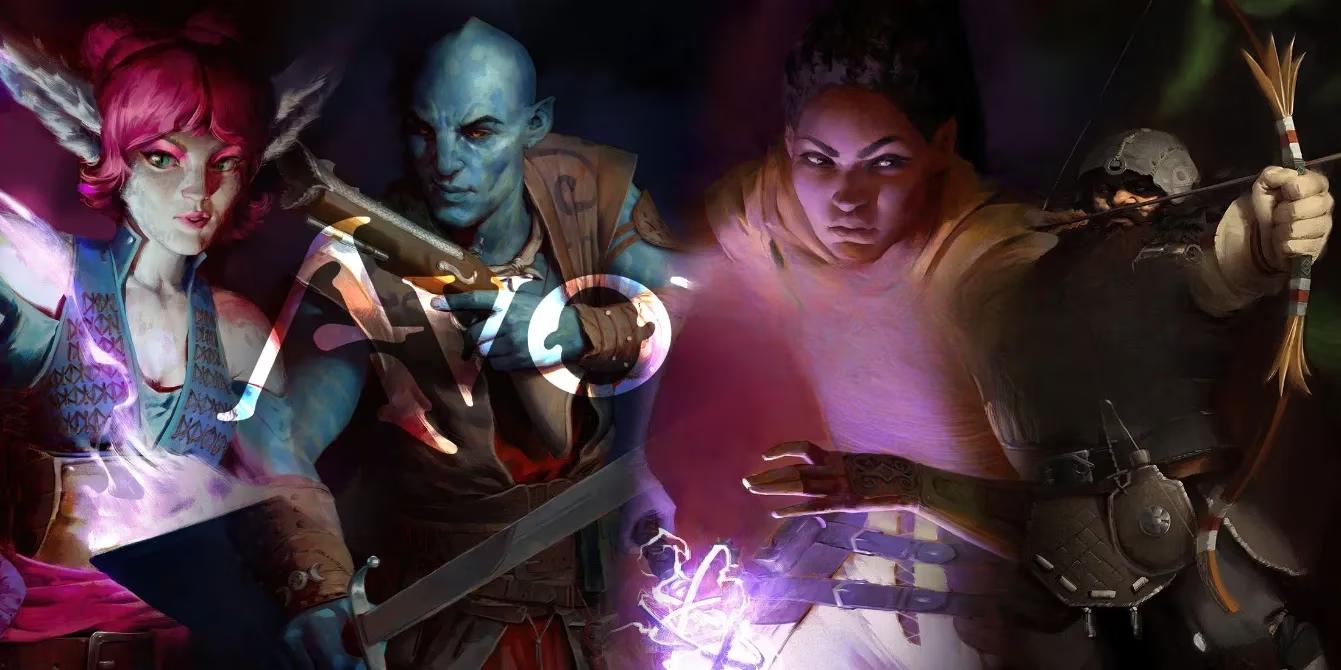
The Liberation of Choice: Unshackled from the Affinity Grind
Most modern RPGs with companion systems operate on a transactional logic. Players are presented with a moral or narrative crossroads, but the calculus is often corrupted by an invisible spreadsheet. ❓ Will this choice please the companion I wish to romance? ❓ Will it unlock their unique combat perk or special ability? The companion becomes a lockbox of benefits, and the player's choices are merely the keys, selected not for their narrative weight but for the treasure inside. This creates a paradox: games that preach player agency often build the very cages that limit it, encouraging a playstyle of calculated appeasement rather than genuine role-playing.
Avowed dismantles this cage entirely. Its companions possess no traditional "affinity" or "approval" mechanics. There is no hidden number ticking up or down, no gameplay bonus dangled like a carrot for good behavior. This design decision is as radical as it is liberating. It means when you stand before a pivotal decision in the Living Lands—perhaps deciding the fate of a besieged village or choosing between two conflicting ancient truths—you are free to consult only your character's conscience. You are not a diplomat managing a council's mood; you are an adventurer making a stand. The freedom is palpable, transforming each choice from a strategic investment into a pure expression of identity.
The Emotional Calculus: When Choices Have Weight, Not Stats
However, the absence of mechanical punishment does not mean an absence of consequence. Obsidian has masterfully shifted the consequence from the mechanical realm to the emotional. Your companions in Avowed are not silent judges keeping score; they are friends, allies, and sometimes ideological opponents with voices they will use.
Imagine this scenario: You are faced with a classic RPG dilemma. A powerful, corrupt noble holds a town in thrall, but his strict rule has also brought a harsh, undeniable peace. The rebellious faction promising freedom is passionate but chaotic and untested.
-
In a traditional system, you might pick the side that aligns with your companion's personal quest to gain +15 Approval and unlock their "Inspiring Leader" aura.
-
In Avowed, you make your choice. Afterwards, the companion who believed in order and stability might not leave your party. Their combat effectiveness won't diminish. Instead, they might walk beside you in stony silence for hours. When they finally speak, their words are not a system notification but a wounded accusation: "I thought you stood for the little people. What you did back there... it protected a throne, not a home."
The consequence isn't a debuff; it's a rift in a relationship you've built through shared struggles. The game presents its biggest dilemmas as moral minefields; no matter where you step, someone you care about is likely to be caught in the blast. This forces a far more engaging and human form of role-play. You are no longer optimizing for reward, but wrestling with the much heavier burden of disappointing someone who trusts you.
Companions as People: The New Standard
This approach transforms companions from game objects into virtual persons. They are not tools in your inventory but echoes of your conscience, constantly reflecting the path you've chosen. Their value lies not in what they give you, but in what they make you feel. The system creates moments of genuine tension and drama that mechanical affinity bars simply cannot replicate.
Consider the long-term impact:
| Traditional RPG Companion | Avowed Companion |
|---|---|
| Relationship is a resource to be managed. | Relationship is a narrative to be experienced. |
| Disagreement triggers a numerical penalty. | Disagreement triggers a personal, emotional response. |
| The goal is often to "max out" affinity. | The goal is to navigate a complex, evolving dynamic. |
| Choices are often made to "game" the system. | Choices are made to define your character's story. |
By removing the transactional layer, Avowed forces players to live with the emotional residue of their decisions. There is no easy reset, no gift-giving minigame to repair a damaged meter. You must journey forward with the tension you've created, knowing that a friend looks at you differently. In doing so, Avowed doesn't just respect player agency; it elevates it. It trusts players to care about the emotional stakes without the crutch of gameplay incentives. It argues that the true reward of a choice-driven narrative isn't a better sword or a new romance scene, but a story that feels authentically, sometimes painfully, your own.
As we look at the RPGs of 2026 and beyond, Avowed's companion philosophy stands as a bold challenge to the genre. It proves that when you treat companions as people and choices as irrevocable threads in a shared tapestry, you create a deeper, more memorable, and ultimately more human experience. The legacy of player choice that Obsidian helped define has not just been continued; it has been profoundly deepened.