
Avowed: The Unseen Immersive Sim Connection to Dishonored in 2026
Avowed blends immersive sim design and RPG freedom, echoing Dishonored, to deliver a dynamic, player-driven adventure in Obsidian's Living Lands.
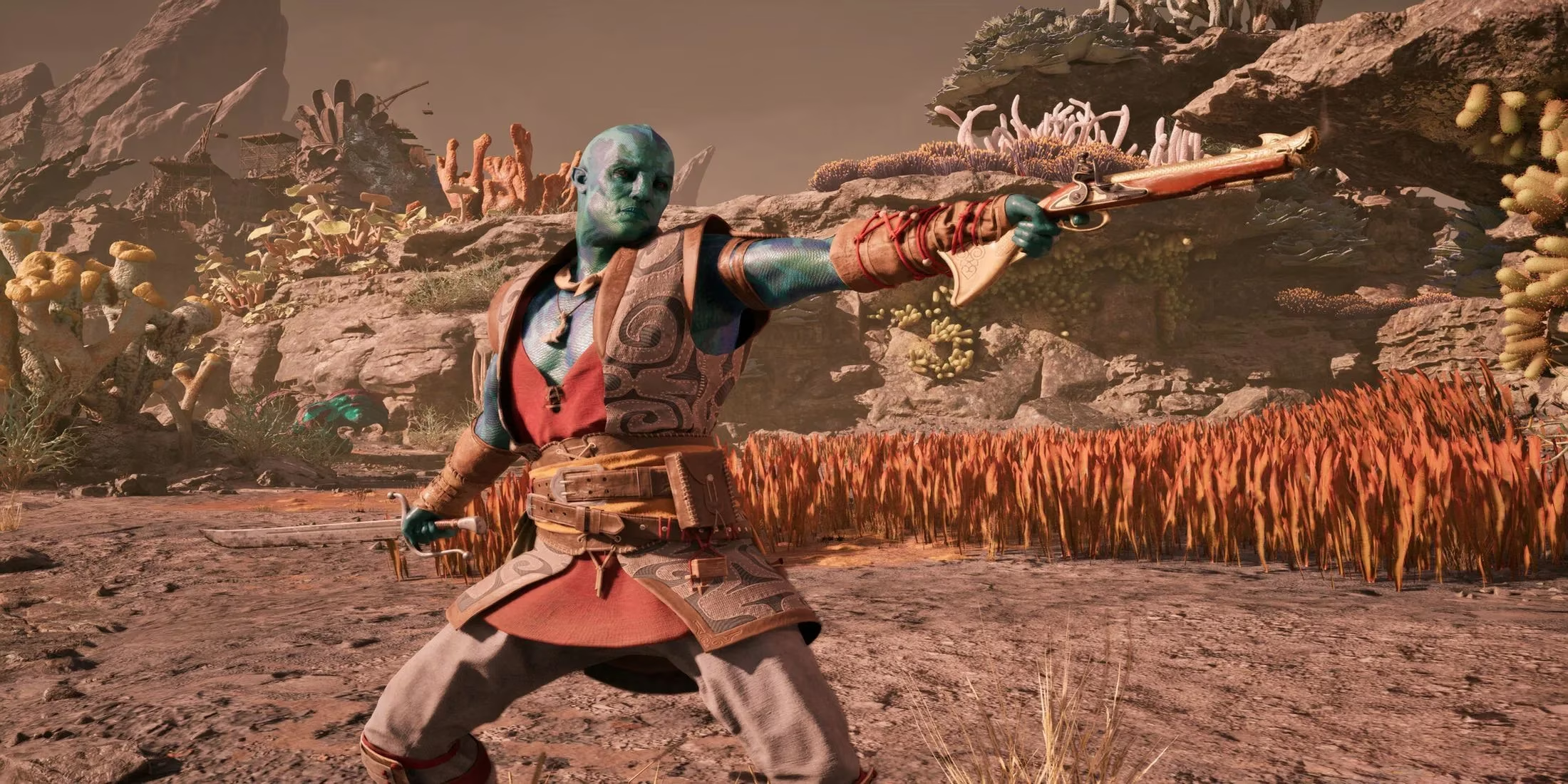
As I dive back into the vibrant and dangerous world of Eora in 2026, it's remarkable to reflect on how Avowed, Obsidian Entertainment's acclaimed first-person RPG, has carved its own unique legacy. Initially drawing surface-level comparisons to giants like Skyrim, the game's deeper, more intricate soul has revealed itself over time, showcasing a profound and deliberate kinship with the immersive sim design philosophy pioneered by Arkane Studios' Dishonored. This connection, perhaps the game's most compelling and unexpected strength, transforms the Living Lands from a mere fantasy backdrop into a dynamic, reactive playground where player creativity is the ultimate weapon.
The Philosophy of Freedom: More Than Just Dialogue Choices
Obsidian has always been synonymous with player agency in narrative, and Avowed delivers this in spades with its complex web of faction allegiances, moral dilemmas, and world-altering decisions. Yet, the studio's commitment to freedom extends far beyond the dialogue wheel. It's woven into the very fabric of gameplay, mirroring Dishonored's core tenet: there is never just one solution. Whether you're the Aedyran Envoy investigating the mysterious Dreamscourge or navigating the political intrigue of the frontier settlements, the game insists you play by your own rules. This philosophy manifests brilliantly in its classless progression system, which dismantles traditional RPG archetypes.
-
Skill-Based Customization: Instead of picking a class like "Fighter" or "Wizard," I built my character from a vast pool of individual skills. I could mix stealthy dagger techniques with explosive elemental magic, creating a hybrid assassin-mage that felt uniquely mine.
-
Dynamic Loadouts: The ability to save two completely different skill and weapon setups, swapping between them instantly, meant I could adapt to any situation. One moment I was a silent ghost, the next a thundering battlemage, all without a single visit to a respec altar.
This foundational flexibility ensures that every playstyle—be it methodical stealth, aggressive combat, or clever environmental manipulation—is not just viable but deeply rewarding. It's the same empowering design that made navigating Dunwall's rooftops in Dishonored so thrilling.
A World That Reacts: Level Design as a Puzzle
Where Avowed's immersive sim DNA truly sings is in its meticulously crafted environments. The sprawling, multi-tiered cities and ancient, cavernous dungeons are not just pretty backdrops; they are intricate puzzles begging to be solved. Exploring them feels less like following a quest marker and more like conducting a heist, constantly scanning for advantages. This level of environmental storytelling and interactivity is a direct lineage from Dishonored's clockwork mansions and fortified outposts.
| Dishonored Element | Avowed Manifestation | Player Experience |
|---|---|---|
| Verticality & Multiple Pathways | Buildings with climbable scaffolds, caves with hidden tunnels, temples with collapsed ceilings. | I constantly looked up and down, finding new routes that bypassed guards or led to secret caches. |
| Reactive Objects & Physics | Explosive barrels, flammable oil slicks, destructible wooden barriers, movable crates. | Combat arenas became chaotic playgrounds where I could ignite oil with a fire spell or collapse a walkway on enemies. |
| Utility Tools as Keys | The Blink ability for traversal. | Avowed's skills are the tools. The Charge ability shattered weak walls. Ice Grenades froze water to create temporary bridges. |
This design encourages and rewards thorough observation. A seemingly dead-end cavern might have a fragile wall hinted at by subtle cracks. A heavily guarded gatehouse could be circumvented entirely by using a combination of parkour and a well-placed ice platform to scale a nearby cliff face. Finding these alternate paths often yielded valuable loot or poignant lore snippets that enriched the world, making exploration its own compelling reward.
The Toolbox of an Envoy: Combat as Creative Expression
Combat in Avowed, much like in Dishonored, is less about stat-checking enemies and more about creatively using your entire arsenal and the environment. The game provides a toolbox, not a rigid rotation. My approach to a bandit camp could vary wildly:
-
The Ghost: Using stealth skills to pick off sentries one by one, hiding bodies, and never raising an alarm. 😶
-
The Architect: Luring enemies into a choke point, then collapsing a stone pillar on them with the Charge ability, or freezing a key fighter solid to isolate them.
-
The Tempest: Leaping into the fray with a sword in one hand and lightning crackling in the other, using parkour to gain the high ground and rain down area-of-effect spells.
The fluid parkour mechanics—sliding, vaulting, and mantling—are integral to this. They turn the environment into a kinetic part of combat, allowing for hit-and-run tactics, rapid repositioning, and spectacular ambushes. This seamless integration of movement, skills, and world interaction is the hallmark of a great immersive sim. It makes every encounter feel like a personal story of how I chose to overcome the odds.
The Legacy in 2026: More Than a Spiritual Successor
Looking back from 2026, the discourse around Avowed has rightly shifted. While it stands proudly as a deep, narrative-driven RPG in the Obsidian tradition, its most enduring praise comes from how it synthesized that tradition with immersive sim principles. It demonstrated that a rich, fantasy RPG world could be as systemic, reactive, and player-driven as the steampunk dystopia of Dishonored.
The game didn't just offer quests with multiple endings; it offered spaces with multiple solutions. It asked not only "What kind of person are you?" but also "How do you solve this problem?" By embracing this dual-layered approach to player freedom, Avowed elevated itself. It became more than the sum of its parts—a game where wielding a sword, a spell, or a simple crate could be equally powerful statements of player agency. For fans of thoughtful, emergent gameplay, the Living Lands remain one of the most rewarding playgrounds in modern gaming, a testament to the timeless appeal of the immersive sim philosophy.