
How Avowed's Ambiguous Dialogue Rewrites RPG Rules in 2026
Avowed review highlights Obsidian Entertainment's masterful RPG dialogue system and impactful, ambiguous choices.
As I sit down to finally pen my thoughts on Obsidian Entertainment's latest masterpiece, Avowed, in this chilly winter of 2026, I find myself still haunted by a conversation I had with a companion last night. Not because of a dramatic twist or a moralistic hammer, but because I genuinely didn't know if I had done the right thing. And that, I now realize, is the highest compliment I can pay to an RPG.
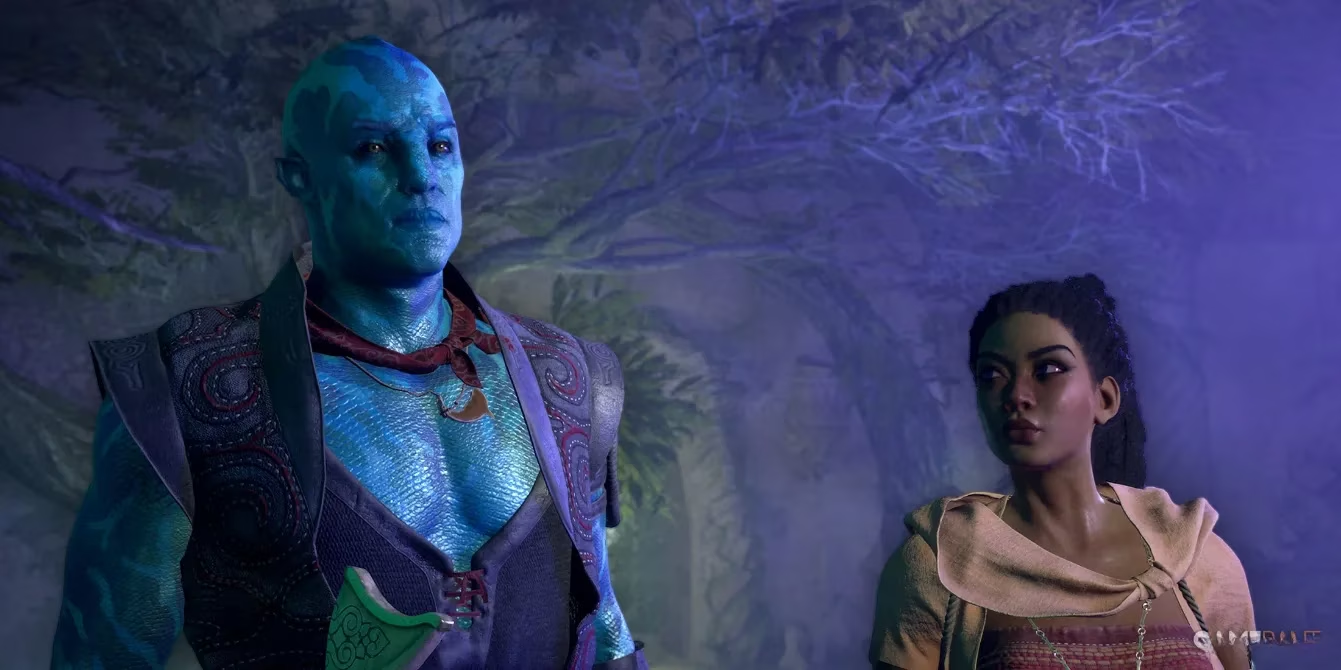
For decades, role-playing games have trained us like lab rats. Press the paragon button to get the hero cookie; pick the renegade quip to watch the world burn. Even the most celebrated titles often fell into the trap of color-coding morality, or worse, spelling out the optimal path through glaring skill-check percentages. Obsidian, a studio that has always worshiped at the altar of narrative depth with titles like Pillars of Eternity, decided to burn that dusty manual with Avowed. The result is a dialogue system that doesn't just support role-playing—it demands it.
The core of my revelation came during a tense standoff between two factions fighting for control of a water source in the Living Lands. I had a history check, a dexterity check, and a simple "attack both" option staring back at me. My gamer brain instinctively hovered over the history check, assuming, as we've been conditioned for twenty years, that a success would offer the most nuanced, rewarding "best" ending. I passed the check. My character calmly explained a forgotten treaty that should have resolved the dispute. Instead of de-escalation, the leader scoffed, feeling his ancient right had been dismissed, and immediately drew his blade. I was forced to slaughter the entire camp, losing a potential merchant and questline permanently. The skill check, the supposed golden ticket, had blown up in my face spectacularly.
This is the brutal beauty of how Avowed redefines conversational design. The game actively deconstructs the stubborn binary of "good" and "evil" paths. Dialogue options are not merely a highway between binary poles; they are a tangled thicket where every branch is shrouded in fog. The developer has removed the safety net of foresight, ensuring that the outcome of each parley is genuinely mysterious until you commit to a choice and live with it. I’ve found myself staring blankly at the screen, frozen not by indecision about which choice yields the best stat reward, but paralyzed by a deep, personal uncertainty. The companions don't help; they will often chime in not to guide you, but to remind you that what matters most is your own conviction. "You made your choice, now stand by it," a companion told me after a disastrous diplomatic blunder that cost us a valuable ally. She wasn't angry, she was just observing the reality of my new world.
What makes this framework so powerfully immersive is its commitment to permanence and restriction. In Avowed, a conversation isn’t a checklist to be exhausted. You rarely get to loop back and ask every single question on the list; often, selecting one path slams the door shut on three others. This scarcity of information forces a player to actually inhabit their character. Are you a cautious scholar who would ask about the history of the ruins before anything else? Doing so might mean you miss the chance to bluff your way through the guards at the gate with a quick tongue. This layered complexity ensures that no two playthroughs will feel the same, as the dialogue tree reacts organically to the sequence and prioritization of your queries, not just the final selection.
The skill checks themselves deserve a separate celebration. They are no longer a guaranteed "I win" button that unlocks a secret bonus ending. A successful might check might intimidate a minor thief, but trying the same brute force on a stoic town marshal could lead to you getting exiled from the settlement. An arcana check might read the magical residue correctly, but voicing that truth could inadvertently reveal a secret that starts a city-wide panic. This shift from what you unlocked to what you unearthed shifts the weight from mechanical progression to narrative consequence. It makes my character’s build feel like a personality, not just a lockpick set.
Coming back to this in 2026, looking back at the last year of releases, it’s startling how singular Avowed’s approach remains. While many modern RPGs overwhelmingly rely on user-interface prompts—little hearts or frowns next to dialogue lines indicating the emotional vector—Avowed trusts its text and its player. The ambiguity is the point. It prioritizes the subtlety of social interaction, the anxiety of a high-stakes gamble where losing is just as valid a story outcome as winning. Every conversation feels like a tightrope walk over a pit of permanent impact, and the emotional weight that comes with that is a masterclass in interactive storytelling.
By finally moving past the kindergarten morality of "right" and "wrong" clickable buttons, Obsidian has handed the pen back to the player. I am no longer a puppet choosing between a blue ribbon and a red one; I am an agent of chaos and order, often simultaneously, struggling with the ambiguity of my own decisions just as I do in the real, non-pixelated world. Avowed doesn't just ask you to play a role; it forces you to own it. And in the landscape of 2026's gaming catalog, that authentic, terrifying, and deeply human experience shines like a beacon of pure role-playing perfection.