
My Journey as the Silent Envoy: Reflections on Avowed's Voiceless Protagonist
The profound silence of a Godlike envoy in the Living Lands masterfully explores the immersive paradox of a defined entity acting as a blank slate. This compelling disconnect between deep, textual role-playing and a voiceless presence creates a uniquely haunting friction within the rich, interactive world.
As I stepped off the creaking ship onto the shores of the Living Lands, the frigid air of Eora's far north bit at my skin. I am an envoy of the Aedyr Empire, a Godlike—touched by the gods before my birth, marked by the faint, fungal-like patterns on my face that shimmer with latent magic. My mission is clear: investigate the dreamscourge, a plague of nightmares spreading like a shadow across this frontier. Yet, from that first moment, I realized something profound about my existence in this world. I am powerful, chosen, and utterly silent.
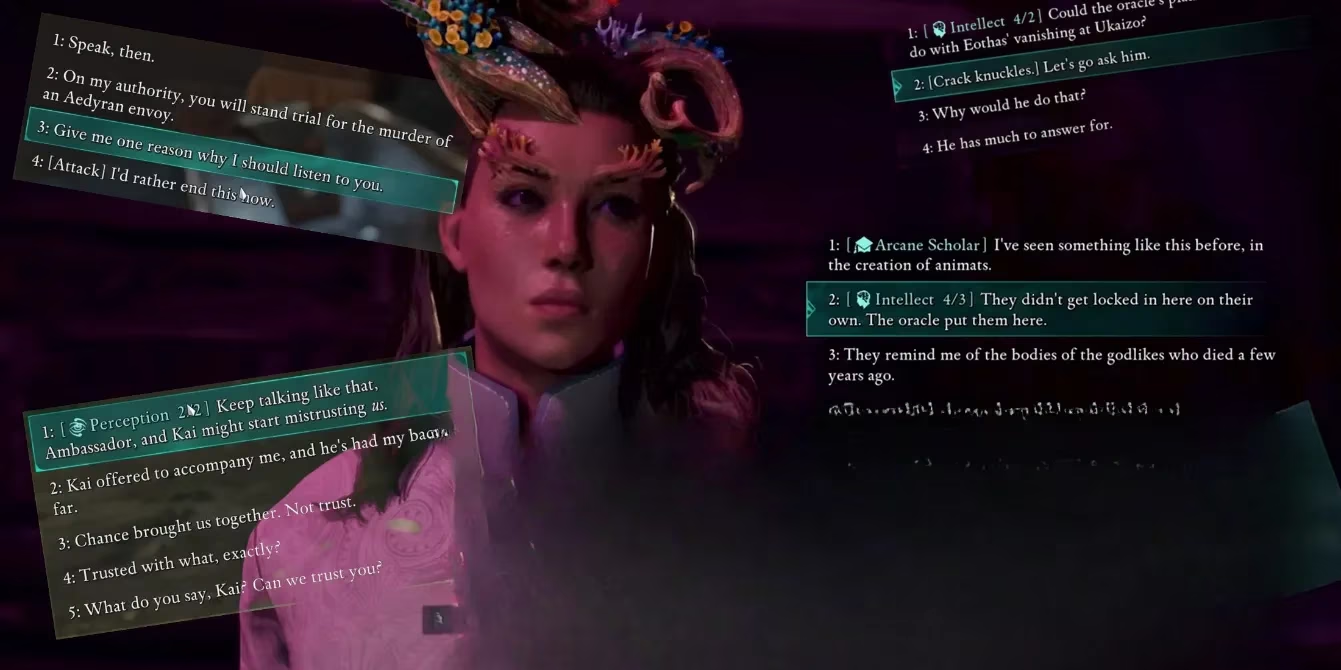
The silence is not for lack of things to say. Oh, the conversations I have! In the makeshift camps of settlers, with wary tribal leaders, and even with echoes of the gods themselves, my mind is a whirlwind of questions, warnings, and decisions. But when an NPC looks me in the eye and pleads for help or threatens war, my response appears only as text on the screen. My lips do not move. My face, which I painstakingly sculpted in the character creator—even opting to tone down my otherworldly Godlike features—remains a placid, unmoving mask. The only sounds I utter are the guttural grunts of effort in combat and the arcane chants that summon fire and ice. In the quiet moments between battles, my silence feels less like a choice and more like a void.
I remember my time in other worlds shaped by Obsidian's hand. In the Mojave Wasteland, I was also a cipher, a courier with a past written by my choices, not by a voice actor. That silence felt fitting there, part of the desolate, DIY spirit of the frontier. But here, in the Living Lands? The environment begs for interaction. The lore is deep, pulled directly from the rich tapestry of Pillars of Eternity. I encounter familiar foes, walk paths hinted at in ancient texts, and the weight of being an Aedyr envoy—a political entity in a volatile land—presses on me. Yet, I express that weight through textual dialogue options that feel strangely disembodied.
The Paradox of Presence: I am a defined entity (an envoy, a Godlike) acting like a blank slate.
Sometimes, the disconnect is jarring. A companion will share a traumatic memory, their voice cracking with emotion, and I will respond with a chosen line of text. The conversation ends, and we stand there. My character model doesn't nod, doesn't frown, doesn't betray a flicker of empathy or rage. It simply... exists. For a game that is, visually, a far cry from the isometric views of Pillars of Eternity and is built for immersion in first-person, this choice creates a constant, low-grade friction against believing I am truly in this world.
I understand the reasons, intellectually. As a player in 2026, I'm aware of the design history:
-
Cost & Customization: Voicing every possible dialogue branch for a fully customizable character is a monumental, expensive task.
-
Player Projection: A silent protagonist is a classic RPG tool to allow players to imprint their own voice, their own inflections, onto the character.
-
Obsidian's Tradition: From Neverwinter Nights 2 to Tyranny, they have often let the player's imagination provide the voice.
But then I think of Alpha Protocol, Obsidian's own experiment from years ago. Agent Michael Thorton was voiced. He was a defined character with a specific attitude, and his spoken interactions in those cinematic dialogue wheels made the espionage drama feel immediate and personal. Avowed sits somewhere in between. I am not a total blank slate; I have a concrete role and origin. Yet, I lack the audible personality of a Michael Thorton.
| Aspect | My Envoy in Avowed | Michael Thorton in Alpha Protocol |
|---|---|---|
| Character Definition | Pre-defined role, customizable appearance | Pre-defined character (name, backstory) |
| Dialogue Delivery | Text-only responses, no lip movement | Fully voiced, cinematic dialogue wheels |
| Player Connection | Relies on textual imagination & choice | Relies on performed personality & choice |
| Immersion Factor | Can break presence in a visual world | Enhances presence in a narrative-driven world |
The dialogue in Avowed isn't the dense, novel-like text of its CRPG predecessors. It's more concise, more action-oriented. This makes the absence of voice acting even more conspicuous. A well-delivered line here could have carried the gravity of a diplomatic threat or the weariness of a long journey. Instead, the emotional heavy-lifting falls entirely on the excellent writing for NPCs and the environmental storytelling—which is superb, but it creates a one-sided relationship.
Would a voiced protagonist have been better? As I stand on a cliffside, watching the eerie glow of the dreamscourge corrupt the valley below, I lean toward yes. Not a constant chatterbox, but a character who reacts. A gasp of surprise, a muttered curse, a tone of conviction when making a pivotal choice. The technology and expectations for RPGs have evolved since the days of Fallout: New Vegas. We live in an era where performance capture can bring digital actors to stunning life. The silence in Avowed feels less like a thoughtful homage to classic RPGs and more like a missed opportunity to fully bridge the gap between its epic Pillars of Eternity legacy and its modern, first-person execution.
My journey as the silent envoy is still profound. The choices I make shape the Living Lands. The allies I gather, the secrets I uncover about my own Godlike nature and the empire I serve—these are the core of the experience, and they are compelling. But in the quiet moments, in the conversations that should resonate with shared humanity (or Godlike-ness), I am a ghost. I speak volumes without making a sound, and the world, for all its beauty and danger, sometimes echoes back into that silence a little too perfectly. Perhaps in another life, in another iteration of Eora, an envoy will arrive with both the power of the gods and the voice to match.