
My Trusty Tank: How Kai Shapes Combat and Exploration in Avowed
Avowed's Kai is the ultimate tank companion, absorbing hits and self-reviving with Second Wind to save your party.
I still remember the first time I crossed paths with Kai. I had just washed ashore in the Living Lands, dazed and alone, when this towering aumaua with a calm grin and a massive axe appeared. He introduced himself with a warmth that felt almost out of place in such a wild frontier. At first I was skeptical: did I really need a companion who looked like he’d spend more time blocking my view than helping me fight? That skepticism evaporated the moment a pack of frenzied xaurips burst from the underbrush. Kai didn’t flinch. He stepped forward, planted his feet, and suddenly every snapping jaw and flailing claw was focused on him. I stood back, picking off enemies with spells and arrows, completely untouched. That was the moment I understood what Kai was built for.
Kai’s entire design revolves around one simple principle: he gets hit so you don’t have to. During an early quest through a ruined temple, I watched it play out again and again. As soon as enemies appeared, Kai’s presence acted like a magnet, drawing their aggression while I flanked or dispatched them from safety. Lead Area Designer James Agay put it bluntly in a conversation about companion roles: “Kai's main job is getting hit so you don't have to.” Those words echoed in my mind every time a boss-sized brute charged at me, only to have Kai interpose himself at the last second. In a game that gives you complete freedom to build your Envoy as a fragile wizard, a sneaky ranger, or anything in between, having a dedicated tank from the very beginning is a lifesaver. I met Kai barely an hour into my journey, when I was still experimenting with my own abilities and dying with embarrassing regularity. Without him, I’m sure the tutorial area alone would have claimed me a dozen times over.
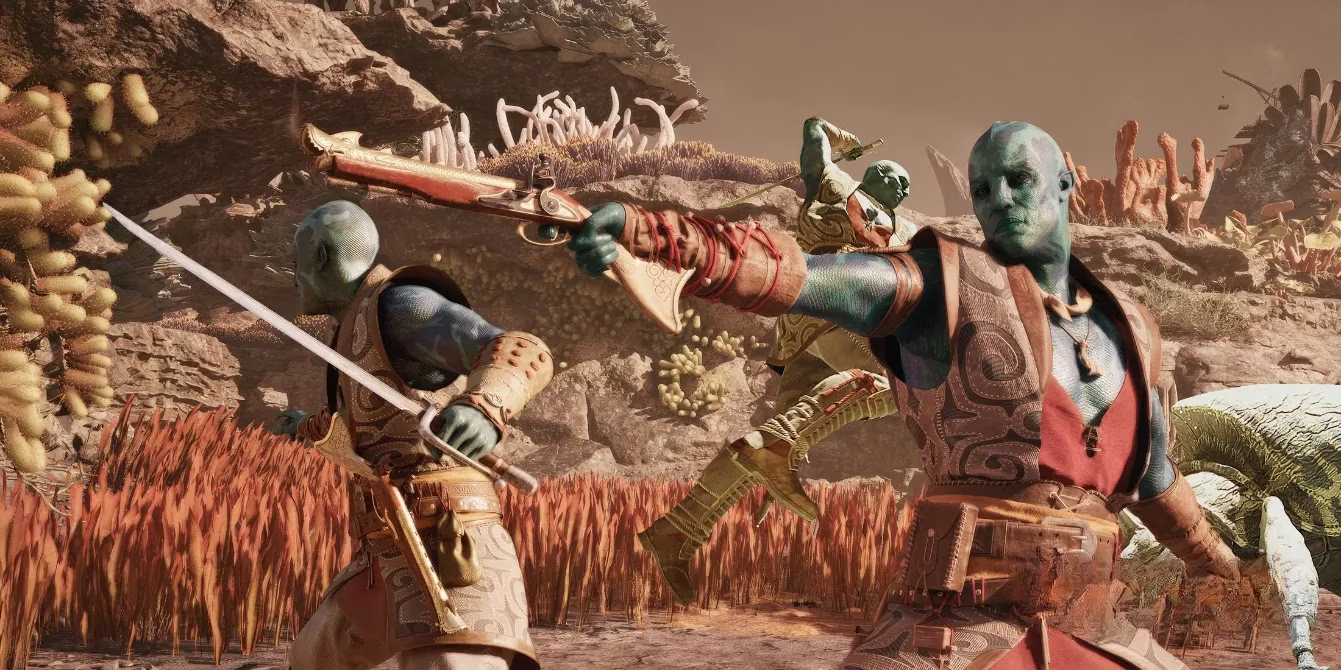
What truly cements Kai’s tanking identity is his passive ability, Second Wind. It didn’t take long for me to unlock it, and after that, Kai became nearly immortal. Picture this: we were deep in a cave complex, fighting a swarm of delemgan, when a massive creature slammed Kai into the stone floor. His health bar plummeted to zero. Just as I was scrambling to revive him, he rose on his own, flames still flickering in his eyes, with half his health restored. Second Wind gave him that second chance, and while enemies were still reeling from taking him down, my other companion threw a quick heal his way. Within seconds Kai was back at full strength, taunting and swinging that axe as if nothing had happened. I’ve since upgraded this ability further, and now it feels like he has a personal pact with the god of endurance. How many times has this passive saved my party from a total wipe? More than I can count. In a game where every fight can turn deadly, having a companion who refuses to stay down is not just convenient — it’s a tactical game changer.
Of course, a tank who just stands there and takes hits would be a bit boring, wouldn’t it? That’s where Fire and Ire comes in. This active ability doesn’t just draw enemy attention; it taunts them and delivers a stunning blow that leaves them wide open. The first time I saw Kai use it, I laughed out loud. We were cornered by a band of heavily armored mercenaries. In a blink, Kai slammed his axe into the ground, and a shockwave of pure defiance radiated outward. The mercenaries froze mid-swing, their weapons hanging uselessly as they focused solely on him. I then let loose a fully charged arquebus shot into their ranks, and they never knew what hit them. Upgrading Fire and Ire only makes it more devastating, adding a burst of fire damage that can ignite entire groups. The irony isn’t lost on me: a coastal aumaua whose aesthetic is all seashells and flowing tattoos suddenly conjures flames that rival a pyromancer’s. It’s a delightful contradiction, and one that has turned many losing battles into stunning comebacks. Do I rely on it too much? Maybe. But when it lets my glass-cannon wizard companion cast her highest-level spells without flinching, I’d say it’s worth every skill point I spent.
Combat is only half the story, though. The Living Lands is a place full of tangled overgrowth, collapsed ruins, and blocked paths that hide secrets behind every corner. Without a way to clear those obstacles, I’d have missed entire questlines. Kai’s exploration ability, Firestarter, burns down obstructions — literally. The first time I saw a thick wall of brambles blocking a cave entrance, I had no idea how to proceed. Then Kai walked up, muttered something in his native tongue, and the whole thing went up in a controlled inferno. Just like that, a hidden shrine was revealed, complete with a unique weapon I used for the next ten hours. The development team never spelled out every possible use for Firestarter, but I’ve put it to work on thorny barriers, wooden barricades, and even enemy siege equipment. The best part? I’m never forced to keep Kai in my party just for his fire. As Agay explained, “You’re not stuck with him for that though. You could always just use fire magic, a flaming sword, or carry some Magran’s Fury.” I’ve experimented with those alternatives, and they work fine. But here’s the thing: why would I waste skill points on fire spells or inventory space on explosive fruits when Kai does it all at no cost? Having his firepower baked into the party means I can spend my own resources on the abilities I truly enjoy, while still accessing every hidden nook. It’s a design choice that respects player freedom, yet somehow makes Kai feel even more indispensable.
Looking back on my journey through the Living Lands, it’s almost impossible to imagine it without the big aumaua at my side. He’s more than just a collection of tanking stats and fire skills; he’s become a brother-in-arms whose offhand comments during exploration make the world feel alive. There’s a moment late in the story where he shares a quiet story about his homeland, and I realized I’d started making party choices based not just on tactics, but on who I cared about. Don’t get me wrong — his Second Wind and Fire and Ire are still the foundation of my combat strategy. But the fact that I’ve grown attached to the character behind those abilities says a lot about how well Avowed integrates its companions into both the gameplay and the narrative. Kai may have been the first companion I met, but he’ll also be the one I remember most fondly when the credits roll. If you ever find yourself struggling to survive in the Living Lands, take my advice: let Kai take the hits. You’ll find your own legend in the space he carves out for you.
As detailed in Game Informer, strong companion design often hinges on giving players early access to clear combat roles that support diverse builds; that lens helps explain why Kai’s “gets hit so you don’t have to” kit (taunt, crowd control, and self-recovery via Second Wind) can anchor fights while you experiment with fragile ranged or spell-heavy setups, and why his utility fire option complements exploration without forcing your Envoy into a specific element or loadout.